
Case Study: Migrating from WordPress to a Modern Data-Driven Platform
Discover how moving from a legacy WordPress site to PrimeCRM improved lead quality, operational visibility, performance, and security while creating a foundation for scalable growth.
Overview
This case study explores how a client transitioned from a legacy WordPress website, which had become difficult to maintain and offered limited operational value, to a modern, structured platform designed to capture, manage, and use customer data effectively.
The Challenge
The client's existing WordPress website had become a liability rather than an asset. While it maintained a basic online presence, it failed to generate meaningful, actionable leads for the business.
Customer enquiries were captured through generic forms and delivered via email, providing little structure or insight into the nature of requests. This limited the organization's ability to prioritise, respond effectively, or extract value from incoming demand.
In addition, the organization had no direct visibility into how marketing activities were performing. Tracking relied on third-party systems, creating fragmented reporting and preventing a clear, unified view of return on investment.
From an operational perspective, the platform was slow and increasingly unwieldy. Performance issues impacted user experience, while content updates were inefficient and dependent on technical intervention.
More critically, the website presented a growing security risk. The previous management provider had not consistently applied updates to core WordPress components or third-party plugins. This resulted in an expanded attack surface and increased exposure to vulnerabilities.
At an executive level, the organization recognized that their website was not supporting growth, was introducing risk, and was failing to integrate into broader business operations.
Objectives
The primary objectives of the migration were clear:
- Replace the legacy WordPress system with a modern, maintainable platform
- Enable structured data capture from customer interactions
- Improve internal visibility of enquiries and requests
- Reduce dependency on plugins and manual processes
- Create a foundation for future integration with internal systems
The Approach
The solution centered around the implementation of PrimeCRM as the foundation for both the website and customer interaction model.
1. Platform Consolidation with PrimeCRM
PrimeCRM was selected to unify the organization's digital presence and operational workflows. This removed reliance on third-party plugins, significantly reducing the security footprint and overall vulnerability exposure while ensuring the platform remains actively maintained and updated.
2. Centralized and Structured Data
Customer data is now captured in a structured format and stored centrally within PrimeCRM. This enables the organization to build a complete view of each customer interaction.
The system supports internal notes, allowing teams to record context against each enquiry, and includes reminder functionality to drive follow-up actions. Sales and marketing teams can manage call sheets effectively, while management gains visibility into both historical activity and upcoming commitments.
3. Operational Visibility and Workflow Enablement
By bringing all interactions into a single system, the organization can now coordinate responses, track progress, and ensure accountability across teams. This has transformed customer enquiries from isolated messages into managed workflows.
4. Improved User Experience
The new website provides a streamlined user experience, guiding customers through clear pathways depending on their needs. This not only improves usability but also increases the quality and relevance of submitted information.
5. Future-Proof Architecture
PrimeCRM's multilingual capabilities provide a clear path for international growth. The client can launch initially in a select list of languages, then use real traffic data to identify demand from other regions and prioritize additional language support accordingly.
This approach allows the organization to validate market demand before committing resources, ensuring that expansion efforts are aligned with real revenue opportunity rather than assumption. As a result, language rollout becomes a commercially driven decision, directly supporting growth strategy and return on investment.
The Outcome
The transition to a modern platform delivered both immediate operational improvements and long-term strategic value.
- Lead quality improved significantly, with structured forms capturing detailed, relevant information about each request
- The organization gained clear visibility into the type, volume, and nature of incoming enquiries
- Marketing performance could be tracked directly within the platform, removing reliance on disconnected third-party systems and enabling more accurate measurement of return on investment
- Response processes became more efficient due to improved data quality and internal tracking
- Website performance improved, delivering a faster and more reliable user experience
- Security risk was substantially reduced through an actively maintained platform with regular updates and controlled dependencies
By moving to PrimeCRM, the client established a system that not only captures demand but qualifies it at the point of entry, enabling better decision-making across the business.
Key Insights
This project highlighted a critical issue faced by many organizations: websites are often treated purely as marketing tools, rather than operational assets.
By rethinking the role of the website, the client was able to transform it into a system that not only attracts customers but also supports the business in managing and responding to demand effectively.
Conclusion
This project was not simply a website replacement. It represented a shift in how the organization viewed its digital presence, from a static marketing tool to a critical component of its operational infrastructure.
The legacy WordPress platform introduced inefficiencies, limited visibility, and unnecessary security risk. In contrast, the implementation of PrimeCRM provided a controlled, actively developed environment where performance, security, and data quality are continuously managed.
For executive teams, the lesson is clear: a website should not only attract attention but also capture and structure demand in a way that supports the business. When properly designed, it becomes a system that informs decision-making, improves responsiveness, and reduces operational risk.
The result is a platform aligned with the organization's strategic objectives, capable of evolving alongside the business.
Are you Ready?
Ready to transform your ideas into reality?
Join the successful organisations using Libertas Software Research to build and design powerful software solutions to meet their needs.
Clients




Latest Knowledge Hub Articles
Latest Knowledge Hub Articles
5 min read
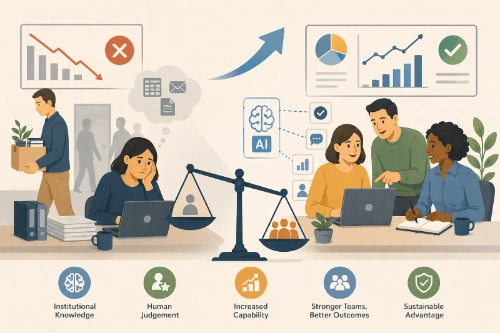
Organisations using AI to cut headcount are making a short-term trade with long-term consequences. The ones holding their teams together and investing in how those teams operate with AI are building something more durable.
21 May 2026
Read More
3 min read
A year on from incorporation, Libertas Software Research has moved from blank page to real clients, real products, and work worth marking.
17 May 2026
Read More
6 min read
Multi Agency Incident Management Systems have moved from optional to essential. Explore why traditional approaches fall short and how modern platforms are closing the gap between planning and execution.
24 Apr 2026
Read MoreNewsletter
Connect on LinkedIn